LPL Financial · Financial services · Phase 3 of 3
Evolving the service
The Planning Services launch exposed product/market fit problems. The mapping surfaced deeper frictions: advisors arriving unready to do their share of the work and a severe data collection hotspot. This case highlights my work on all fronts: advisor behavior, our process, and the offering itself.
- Role
- Principal Product Designer
- Timeframe
- Aug 2023 – 2025
- Team
- 3 product managers
Sr. designer (direct report)
Client Success manager and staff (4)
VP Financial Planning Success and staff (3) - Responsibilities
- Service designDiscovery researchProcess mappingConcept designValidation research
The shift
From making every screen myself to leading the research that decided what came next.
Instead of designing every screen for a 0 → 1 launch, I focused primarily on leading research to fix service design problems that post-launch observation and my mapping revealed.
The problem
Adoption was never the problem. The underlying service design was.Five projects aimed to fix the biggest problems.
The behavior
Advisors arrived unready, or unwilling, to do their share of the work: the one friction every process map shared, and nothing in the system could make them.
The process
Collecting client financial data was heavy, manual work: planners transcribing statements account by account, waiting on documents that came late or not at all.
The model
A subscription per plan type made engaging expensive, so advisors bought less and hoarded credits, and the one-size engagement didn't fit mature practices.
Better assessing advisor readiness
01 · The Behavior · Onboarding Revamp · Spring–Summer 2024
Advisor accountability was everyone's problem but no one's job.
The problem, heading into 2024
1 in 5
active advisors had no plan (96 of 559)
60
advisors terminated since 2022
Leadership suspected, and my previous mapping confirmed, that a lack of advisor accountability and compliance were working against operations, but they didn't know why or how to fix.
What I did
I conducted the research to give them insight and possible solutions so they could choose how to solve the problem. To do this, I ran interviews across Sales, Client Success, delivery managers and advisors to find the real fault line.
The data first revealed internal teams pointing fingers at each other...
Delivery teams said
Advisors didn't understand our process, bought the wrong subscriptions, weren't prepared for their side of the work, creating rework that backed up the pipeline.
Client Success said
Sales didn't set expectations in the sales cycle, and the handoff from sales to activation was poor.
Sales said
They were just doing their job, and pointed the finger right back at Client Success.
...and advisors getting caught in the crossfire.
“Showing me how great the software is is cool, but now I have no support and I don't know where to start, I'm just a deer in the headlights.”
The dominant finding: we don't assess well, and we overload advisors with information.
Why don't we assess well?
The onboarding questionnaire gauged advisor confidence, not ability. I proposed making it skills-based and objective, and ran deep-dive sessions with the plan managers I'd interviewed earlier to tease out the skills that mattered.
The skills we tested for
We defined six candidate skill areas and built the question bank against them, every question tied to what it reveals and where it routes an advisor for training.
Planning assumptions
Reveals planning depth
Data collection
Maturity of their process
Scenario creation
Can they stress-test a plan
Presenting
Can they carry it to the client
Reports & deliverables
Software competency, made visible
Practice & client mix
Routes to the right specialists
The fix I designed · the readiness questionnaire
Onboarding stopped asking advisors how they felt, and started asking what they could do.
Before · Confidence based
“How proficient are you in your planning software?” 1–5
A self-rating on an undefined scale. Emotional, not evidence. My margin note at the time: “should be skills based for accuracy; not emotional.”
After · Skills based
Planning assumptions
QHow often do you update your investment assumptions?
Data collection
QHow do you collect client data?
Scenario creation
QDo you use the Decision Center or Goal Planner?
Questions that demonstrate competence and surface concrete behavioral signals, scored across the six skill areas above.
The Outcome
Every advisor lands in a readiness segment, and every segment routes to different training.
Readiness score
FROM THE QUESTIONNAIRE
New to advising, new to planning
Routes to its own training track
Experienced advisor, new to planning
Routes to its own training track
Experienced advisor, experienced planner
Routes to its own training track
What I learned
Advisors hold the power in this relationship.
They're customers, not staff. They pay for the service, and the firm prioritizes keeping them. That reality, plus budget and dev constraints, ruled out system enforcement as a solution.
When customers can't be compelled, teams need creative ways to achieve the same goal. A service design approach that targets training and skill development often can be very helpful.
Impact
57
pain points surfaced across four functions
17
themes, prioritized for leadership
3
new readiness segments advisors routed into
Reworked the onboarding questionnaire into a skills-based readiness assessment, so onboarding measures what advisors can do and routes them into the right training.
Overhauled Sales and Client Success onboarding artifacts, so every advisor hears one consistent story about responsibilities, timelines, and expectations.
View Onboarding Revamp: The Sequence Leadership Funded
I presented the findings as a prioritized list of problems with candidate fixes. Leadership chose the sequence:
- Revise the questionnaire.
- Redesign Client Success's advisor-facing artifacts.
- Author new training articles in Resource Center.
- Spin up FP Accelerator, a training pilot including a dozen advisors, to address skills development.
The questionnaire touched every advisor who onboarded into the service; FP Accelerator tested whether intensive training could fix what a better filter could only catch.
The remaining recommendations were sequenced into a roadmap leadership planned to continue after I left.
Building advisor skills
02 · The Behavior · FP Accelerator · H1 2025
Turning a research finding into a 12-week training program.
The onboarding research pointed past process to a deeper need, advisors had to get better at planning itself. That became FP Accelerator: a 12-week, six-module program built with our PM and LPL's Financial Planning Success group.
What I did
I provided oversight of content and brand compliance for the supporting materials my sr. designer created. I also owned and led all research designing the surveys and authoring the findings.
Impact
60
net-new planning resources across 6 modules
CFP CE
every module approved for continuing education credit
4.0–5.0
module usefulness (1–5, directional)
View FP Accelerator: What the Research Found
It worked, with a caveat I refused to bury. Modules rated 4.0 to 5.0 for usefulness; one advisor credited the program's values-cards exercise with winning a $1M+ account, and several committed to start charging for planning.
On the other hand, engagement ran thin. Since no participant attended all twelve sessions, office-hours attendance trailed around 39%, and only a handful completed surveys, I reported every number as directional and was explicit about a wide margin of error rather than dressing it up.
The response curve told the story on its own: 39 percent for the first survey, five percent by the last. When the surveys stalled, I repurposed the planned 1:1 interviews to recover the unanswered questions instead.
Survey response by instrument · the fatigue curve
- 39%Modules 1–3
- 17%Module 4
- 16%Module 5
- 16%Module 6
- 5%Overall program
The clearest signal wasn't a score, it was fatigue. Advisors valued the material but couldn't absorb it all at the live pace. Handouts rated strongest across every survey, advisors wanted artifacts they could use, not sessions they had to attend, which shaped the recommendation:
- Give the content a permanent home in an LMS
- Pre-record instruction, reserve live time for office hours
- Lighten the surveying
- Segment the program by advisor type
A second cohort was scoped on that plan.
The pilot independently landed on the same answer the questionnaire was built for: segment advisors and tailor the path.
“There was a lot of material shared and everything goes really fast, so much information.”
Relieving a critical bottleneck
03 · The Process · Digital Fact Finder · Feb 2023 – end of 2023
Digital Fact Finder: attacking advisor non-compliance from the client side.
For every line, advisors sat on the required data and documents the work depends on. Since they are the customer, not staff, we couldn't push harder on the advisor. The solution had to go to the client instead. This third bet shrank the work itself providing a tool that rerouted data collection to the client.
What I did
I supervised the designs my sr. designer created, ran the validation research that drove its revisions, and negotiated with the product manager to prioritize and make them happen.
Impact
26
screens validated with 7 investors
34
recommendations documented for the build team
14
recommendations verifiably shipped, traced screen by screen
Restructured the retirement goal model after 7 of 7 investors were confused by the v1 form, so the product now asks about retirement the way clients actually think about it.
Killed a product-wide labeling pattern after the OWNER field failed with every participant who met it, replacing it with plain questions like “Whose income is this?”
Since I switched projects before post-launch business data came in I can't claim business performance metrics. Impact, here, is traced from validated findings to shipped production screens.
View Digital Fact Finder: Research-driven Revisions
7 moderated sessions · usertesting.com · Sept 2023 · $300K+ net worth, each working with an advisor
I wrote the facilitation guide, recruited the panel, moderated all seven sessions on usertesting.com, extracted raw data to excel where I analyzed it, and created a findings and recommendations deck.
The readout became the revision backlog for the next build, and I negotiated with the product manager to prioritize highest value first.
Validation → production
What testing changed
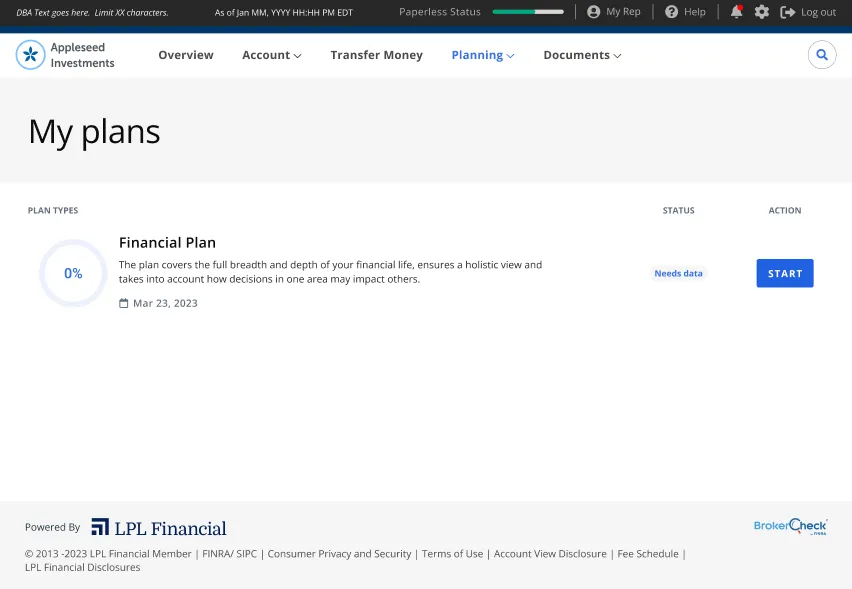
My plans
S18Before
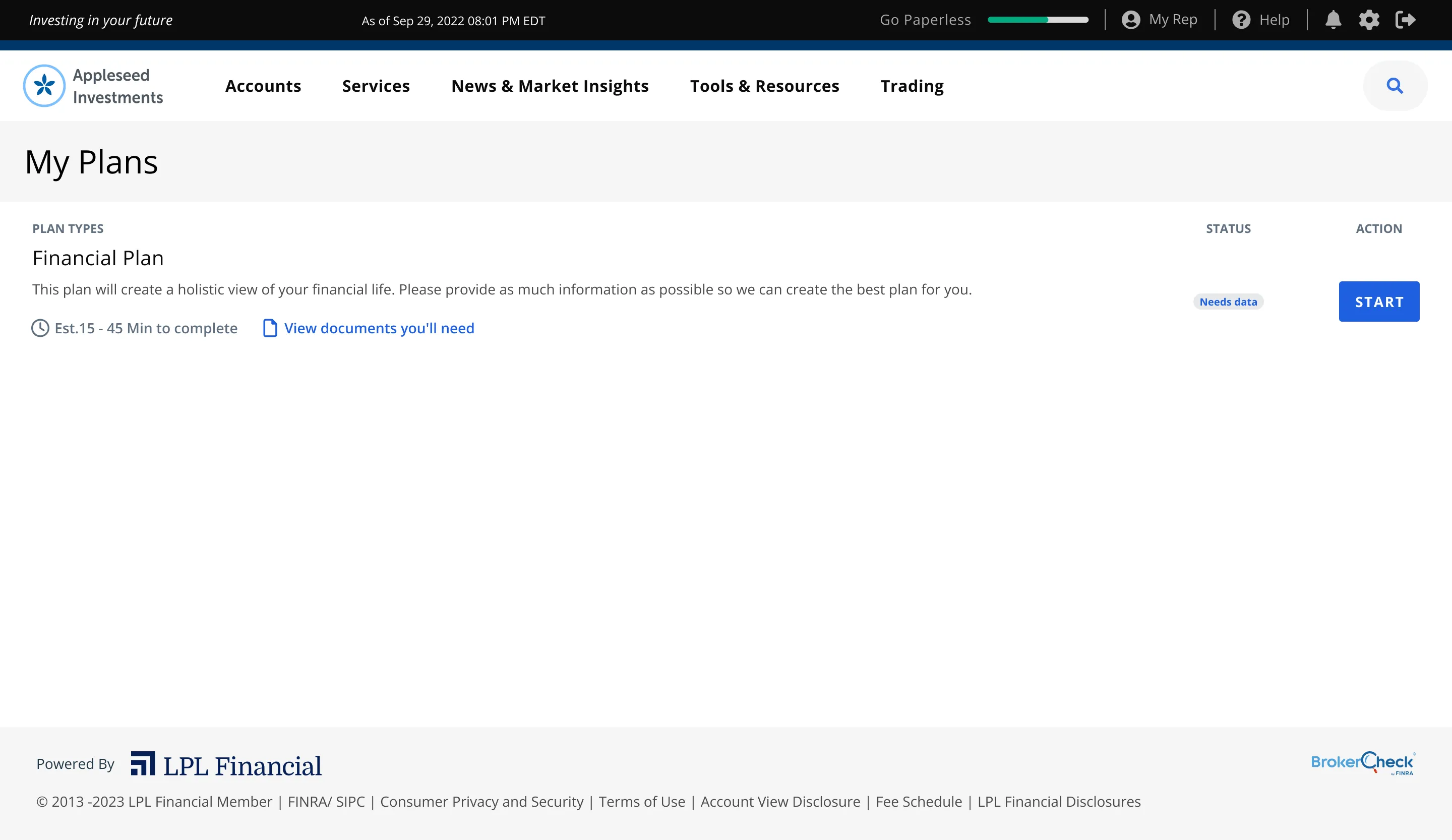
After
What testing found
Users thought it was important to know up front how long the form might take to complete. They also wanted to know which documents to have on hand so they could complete the form more easily.
What shipped
We added a time estimate and a short list of the documents and materials required to finish the flow.
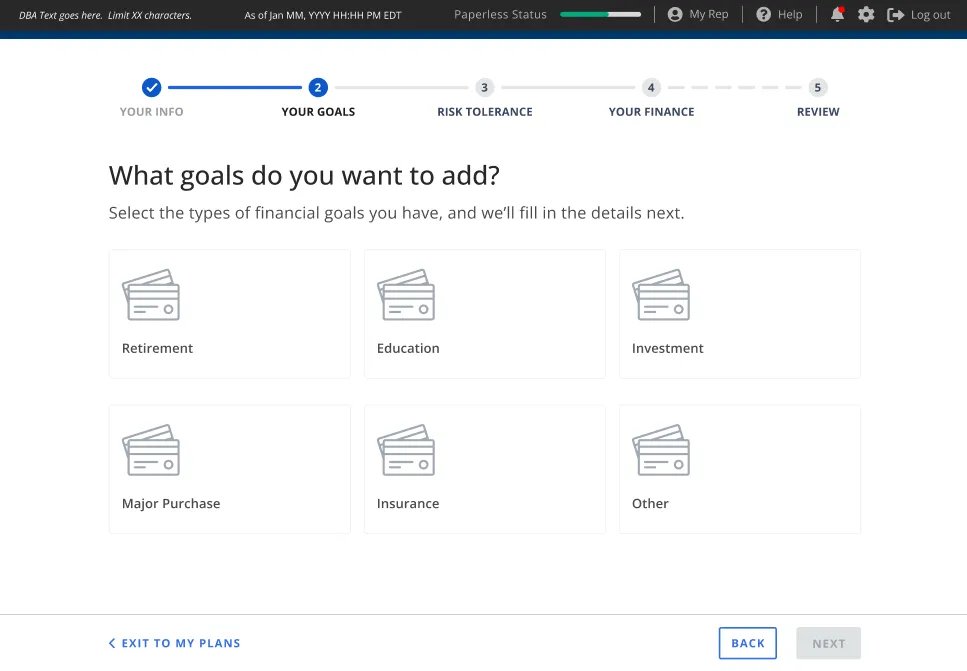
What goals to add
S24Before
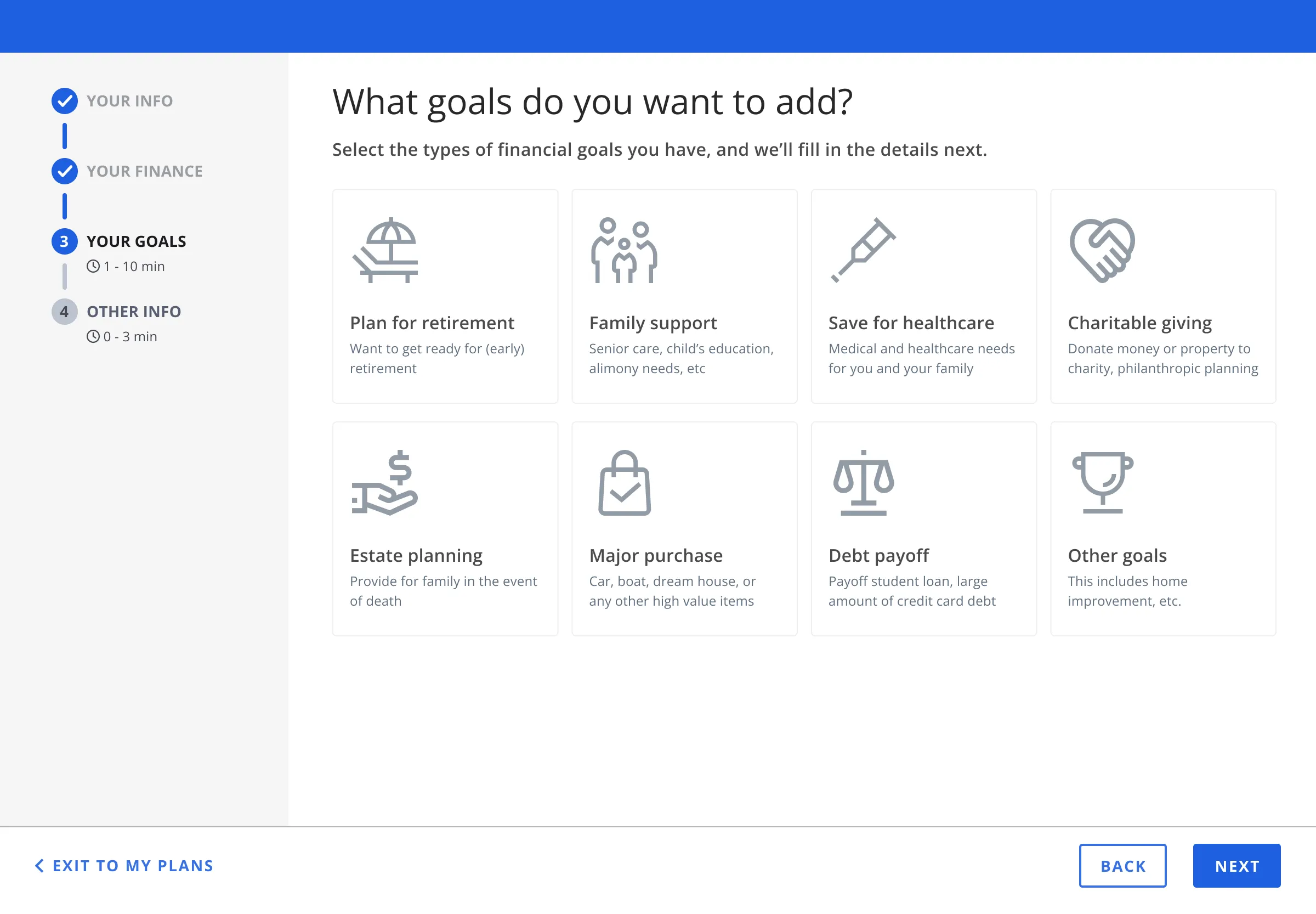
After
What testing found
The progress indicator did not give a clear enough read on where users were in the flow. Some were not sure what a category meant before choosing it. A few were not clear on what “investment” covered. A significant minority named healthcare and estate planning as gaps.
What shipped
We changed the orientation of the progress indicator so it scales and shows progress at a more granular level. We added a description to each category so users understand it before deciding. We added Healthcare and Estate planning as goal categories.
Retirement goals
S26Before
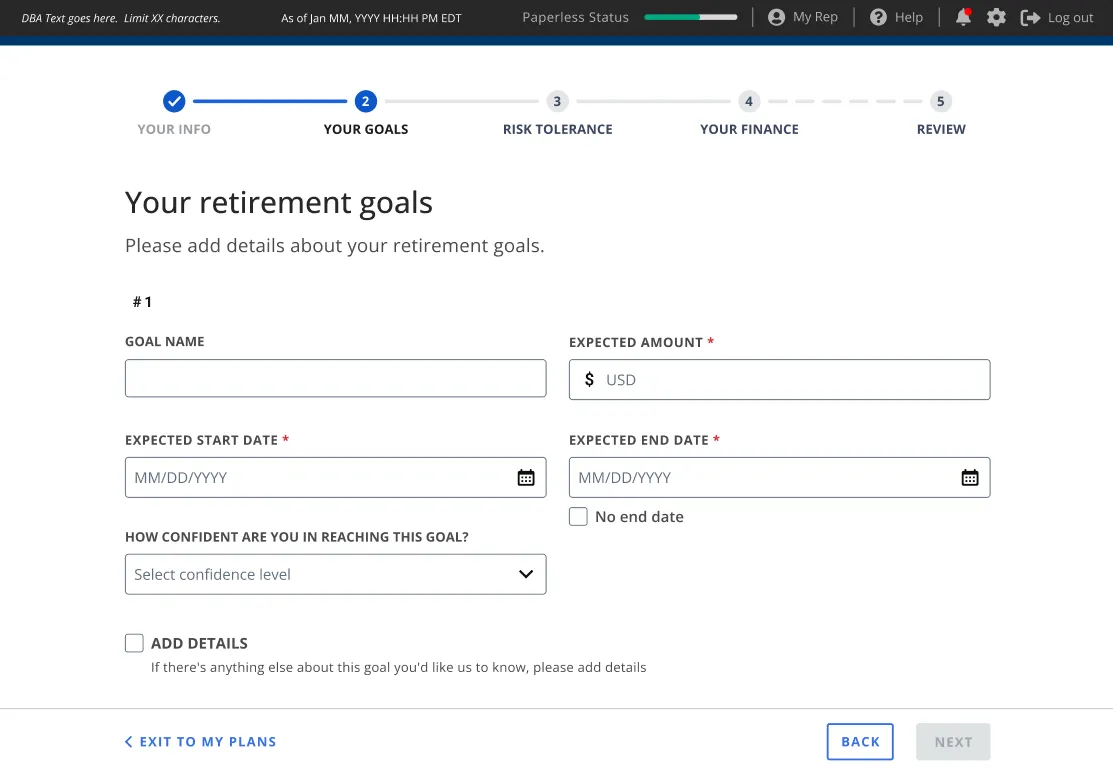
After
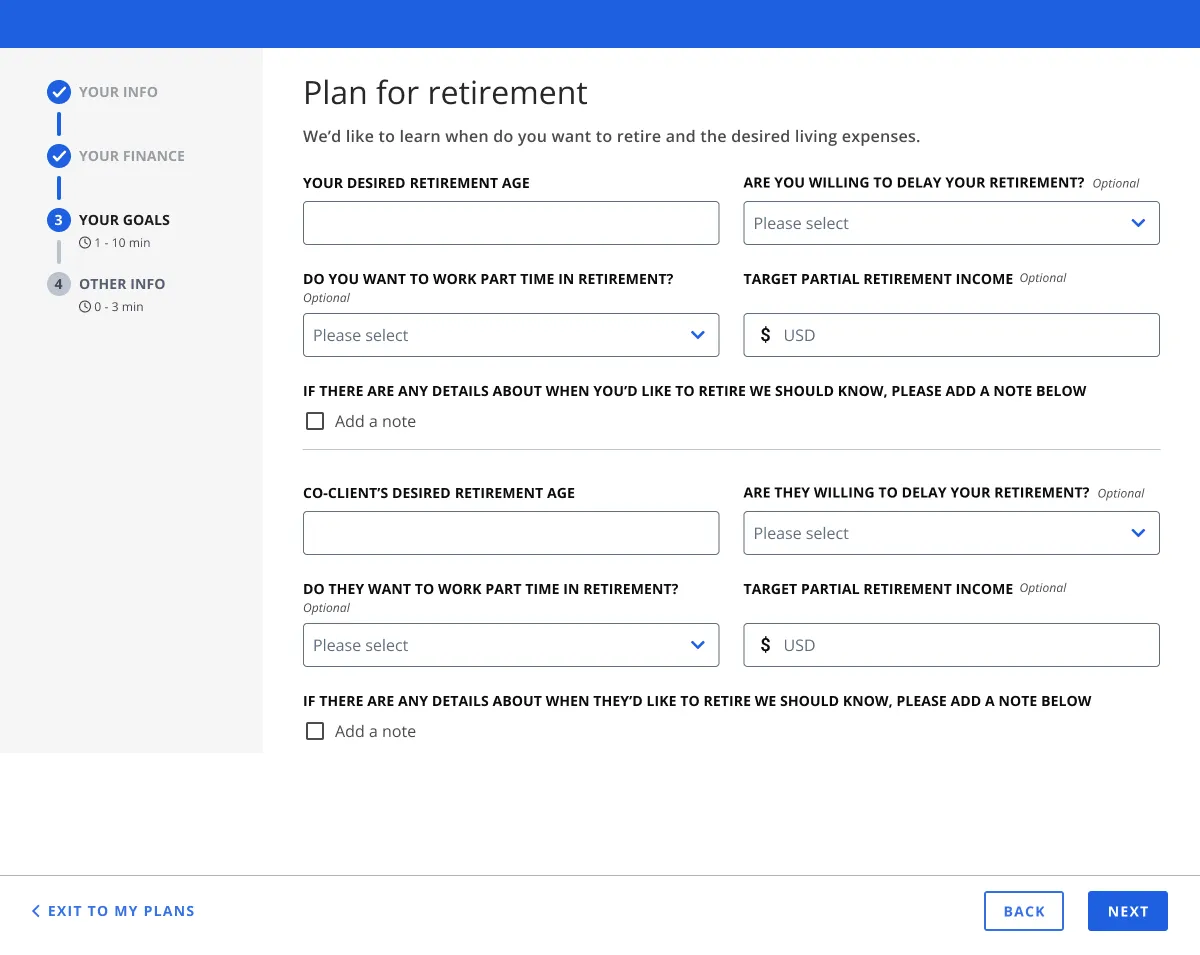
What testing found
It departed from how people actually think about a retirement goal, so it needed a rethink and a restructure of the information we asked for.
“for me retirement goal is specific to retirement and when (date or age) I want to do it and how I want to do it (how much wealth I need)”
“Why would you have multiple retirement goals?”
“Goal name #1...I’m not sure about that. I thought this was retirement so I’m not sure why I have to add a goal name to retirement...I already have a retirement goal. My goal is to retire.”
What shipped
We restructured the form around how people actually think about retirement. Production asks for retirement age, willingness to delay, part-time work plans, and a target for partial income, for both client and co-client. No goal names.
Living expenses
S33Before
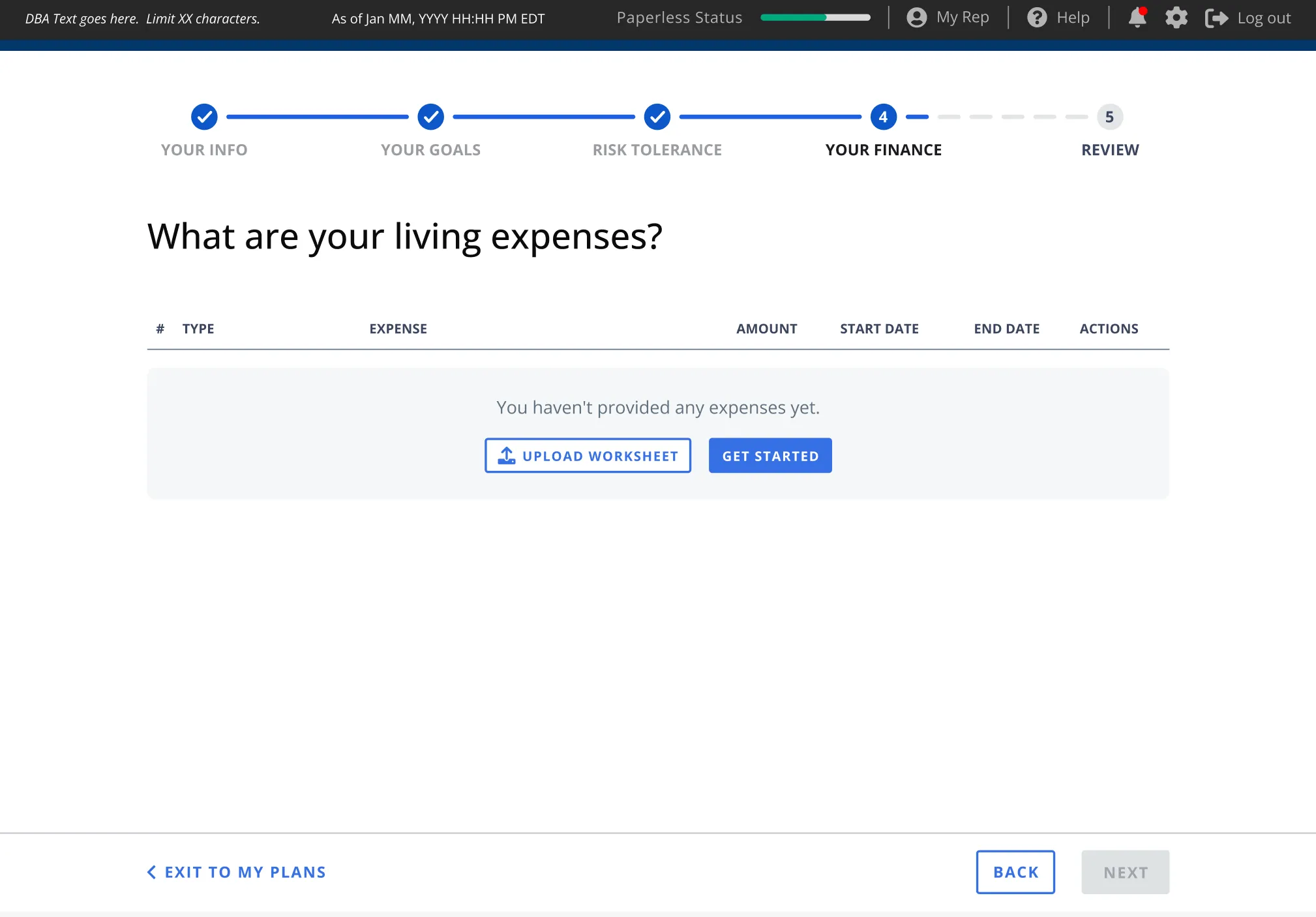
After
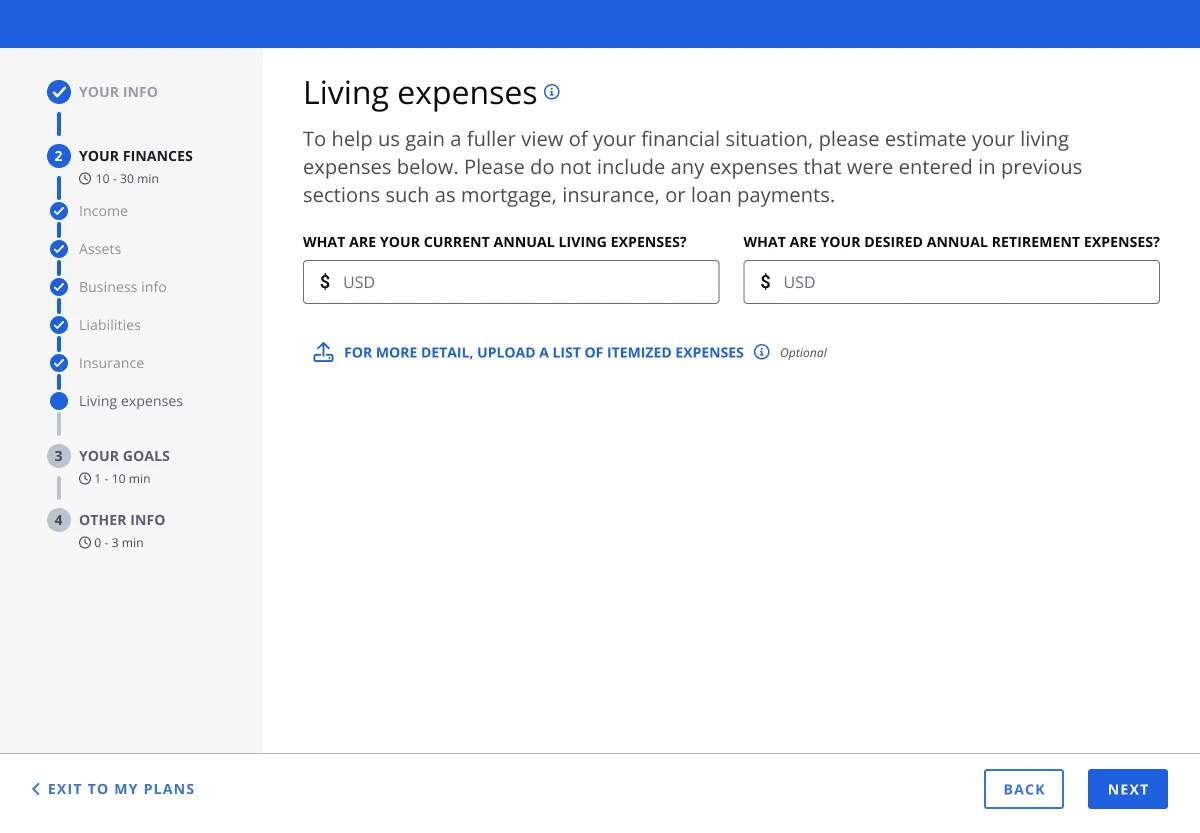
What testing found
Participants found this page heavy and wanted it simplified. About half said they would rather just upload a spreadsheet of their expenses.
What shipped
We simplified the page, and we worked with the delivery team to cut the minimum required data. After that consultation they agreed to two aggregate buckets: current annual expenses and targeted annual retirement expenses.
Solving for ease of business
04 · The Model · Flex Credits · Summer–end of 2024, launched 2025
The subscription model was holding advisors back.
Since advisors had to buy a separate subscription for each plan type they wanted produced using the service got expensive. They engaged less, and unused credits piled up.
The fix was Flex Credits: one pool of credits an advisor spends on any plan.
What I did
I ran the research that showed advisors wanted it, designed the request flow, and validated it before launch.
Discovery research not included in this case due to lack of artifact access.
“Seeing how many credits I've used almost gamifies it, it makes me want to go back and use more credits.”
Impact
3.8 → 4.6
satisfaction, status quo → redesigned flow
100%
completed the plan-request flow, no problems
n=5
directional, pre-launch validation
View Flex Credits: Executive Summary and Recommendations
Validation test · 5 practicing advisors · UserTesting · Nov 2024 · 11–32 years in the business, $17M–$520M AUM
Goal
Before Flex Credits deployed, find out whether advisors would find the new experience disorienting, and whether the in-app content supported understanding and use.
Key findings
Satisfaction· Pass
Navigation· Pass
100% navigated the main request flow. Room to improve access to contextual info.
Task completion· Pass
100% completed Core and Comprehensive plan requests, and did it easily.
Content clarity· Flag
All five had notes to improve the plan-type and credits modals.
Shopping cart· Pass
100% understood the cart, with room to improve.
Visual design· Flag
All five had notes to improve visual aspects of the app.
Top recommendations
Content
Make content findable, clear, and relevant. The plan-type modal is clear but needs more specific product detail.
Visual design
Redesign the cues, and possibly the layout, for the credit balance and message, which gets lost on the page.
What I did with the findings
The full backlog ran long. These are the findings that changed a decision, not the whole list.
100%
What testing foundAdvisors preferred one fungible credit over a subscription per plan type and credits over “hours,” which felt like an attorney’s meter.
What I recommendedCommit to the single credit pool and express it in credits.
60%
What testing foundAdvisors would rather just talk to their planner than fill in structured notes before the first meeting.
What I recommendedCut the questions rather than polish them. They stayed in, despite what the research said.
40%
What testing foundAdvisors said the Core plan was overkill for its purpose, with more investment review and data gathering than the plan needed.
What I recommendedSimplify it to an estimate-based version. A scope call, not just a polish pass.
60%
What testing foundAdvisors could not quickly find the new credit balance and message on the page.
What I recommendedReinforce it visually, so the one piece of information the model depends on is the piece people actually see.
100%
What testing foundAdvisors valued the sample plan as the best preview of what they would get, and two called its length exactly right.
What I recommendedKeep it central and build the modal content around it.
Percentages out of five, directional. Full findings and recommendations backlog lived in the research deck.
Sharpening product-market fit
05 · The Model · Planning 360 · 2024, results Feb 2025
Break the all-or-nothing engagement into an à la carte offering.
Every plan, paraplanning, advanced, tax, estate, high-net-worth, was sold as a full end-to-end engagement. Great for advisors early in their careers; wrong for mature practices with their own process and staff. The à la carte offering found real market fit in the pilot, but the harder question was could Planning Services and Planning 360 share a single app experience?
What I did
I conducted discovery and VOC research to help shape the pilot.
Once the pilot proved the service was viable, I conducted validation research on concepts my senior designer created to show both the legacy Planning Services and the new Planning 360 co-existing in the app.
Impact
The Model
Advisor engagement
7×
increase in advisor engagement
Margin
break-even → 30%
profitability margin
The Validation Test
Current offline way
4.75
avg. satisfaction
Two in-app flows
3.3–3.7
avg. satisfaction, neither beat offline
Visual design
100%
of advisors liked the craft
Average advisor satisfaction, 1–5 scale (n=7, directional).
Scale asks “this makes my job…” 1 = a lot harder · 2 = harder · 3 = no impact · 4 = easier · 5 = a lot easier.
View Planning 360: Executive Summary and Recommendations
Validation test · 7 advisors (4 both subscriptions, 3 paraplanning-only) · UserTesting · December 2024
Goal
Test how advisors perceived two in-app designs for Planning 360, whether co-mingling Paraplanning and Planning 360 in one experience was problematic, and how to improve. I spoke with four advisors who held both subscriptions and three who held paraplanning only.
Key findings
Avg. rating· Pass
The offline path advisors already used out-rated both designed flows. Offline P360 4.75, current Para app 3.4, designed WF1 3.3, designed WF2 3.7.
Visual design· Pass
100% of advisors said they were pleased with the visual design of the experience.
Content clarity· Pass
With minor exceptions, advisors viewed the content as clear and easy to understand.
Navigation· Pass
Navigating the experience presented no major problems for advisors in the test.
Scanning / findability· Pass
Advisors had no issues finding task-based information and instructions.
Information architecture· Flag
Real work remains on the Planning 360 menu IA, especially around key info missing from the menu and service-level form fields.
Usability / goal completion· Flag
Advisors liked both flows but showed significant confusion in WF2 while pivoting from a Paraplanning request to Planning 360 tasks.
Average satisfaction, 1–5
Scale asks “this makes my job…” 1 = a lot harder · 2 = harder · 3 = no impact · 4 = easier · 5 = a lot easier. n=7, directional.
Top recommendations
Redesign the WF2 request summary
Rebuild it to hold both Paraplanning and Planning 360 as always-present sections, reconsider info load and scale, and rethink the Contact Planner placement.
Question the app as the channel
The test surfaced a strong signal that advisors prefer not to use the app. Run further discovery to learn why, and decide whether the app is the best, or only, way to field advisor requests.
Major proposed recommendations
83%
What testing foundAdvisors believed key info was missing from the Planning 360 menu: expected task completion time, SLAs, and due dates. 43% also wanted to prioritize ordered services against a limited bucket of hours.
What I recommendedAdd SLAs, due dates, and pricing to the Planning 360 service data model, and carry the information architecture into the upcoming task-management discovery before building.
43%
What testing foundAdvisors were confused how a single request summary would hold items pulled from two menus priced in different currencies, credits and hours.
What I recommendedIterate for a better mental-model match: add help content and reconfigure the request summary so the workflow reads clearly.
71%
What testing foundAdvisors were unclear how to add another request when faced with two buttons, “Submit request” and “Create another request.”
What I recommendedA low-effort fix first: relabel the buttons in plain terms. Then run deeper discovery to get the affordances and expectations right.
57%
What testing foundAdvisors believed info was missing (the same items as WF1) and were confused that the request summary did not show two sections.
What I recommendedAdd task completion, due date, and price to the data model, run a full IA exercise as in WF1, and redesign the request summary to show separate Para and P360 sections, accounting for scale.
Full findings and recommendations backlog lived in the research deck.
The work I trained for
What I was really designing was the service, not just the screen.
And I loved it.
Leadership decided these projects based on my research, and together they cover the service end-to-end, not just the interface. Onboarding needed a way to route advisors. FP Accelerator worked, but my research showed advisors wanted a more convenient program. The Digital Fact finder did become a screen, but there the right solution involved the client. Flex Credits eased advisor shopping, and Planning 360 found real market fit though the evidence indicated a non-digital solution.
I trained in service design under Mary Jo Bitner, one of the field's foundational voices, who taught me how to do my first blueprints. I had pushed to practice it for years, on projects that never had or made room for it. This stage was the exception. The job comprises pure service design across behavior, process, business model, and digital, and it was an absolute joy to do.